The AI Survival Audit: How to Build a "Career Fortress" for the Class of 2033
Stop waiting for university permission. Start building your own lab.

Author: Masaru @ The Engineering Dad
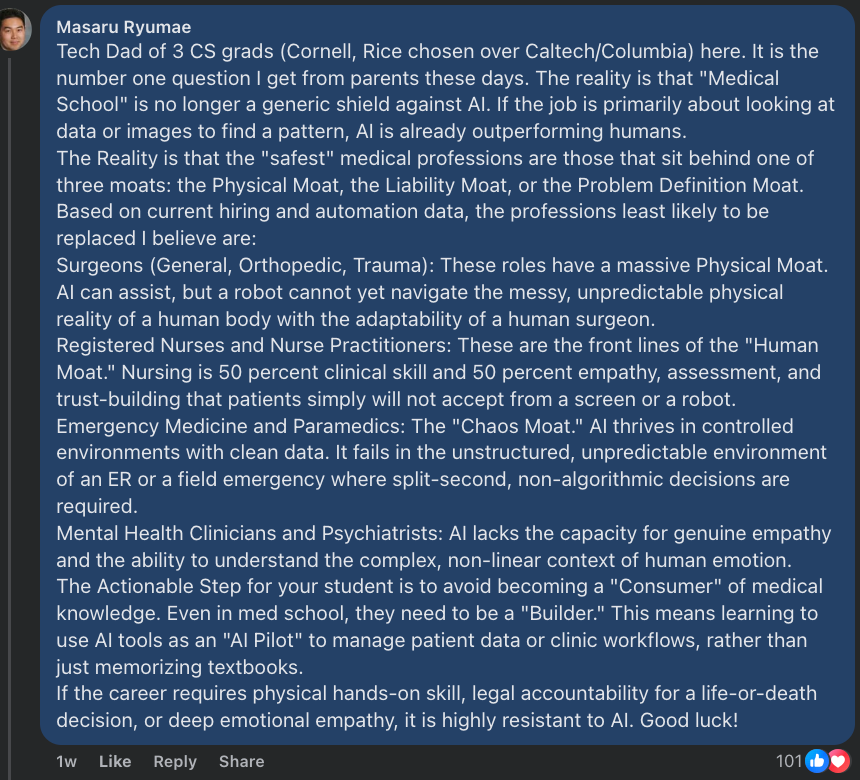
Tech Dad of 3 CS grads (Cornell, Rice chosen over Caltech/Columbia) here. From time to time, my comments to various FB groups get high number of likes. These days, these comments appear to be related to AI.
I have been seeing a familiar wave of anxiety in parent groups this week. Whether your student is looking at Medical School or Computer Science, the question is the same: “Is this degree going to be obsolete by the time they graduate?”
Here’s a gist of one example: My son’s friend just graduated with a Marketing degree and has zero offers. Meanwhile, I’m seeing “T5” CS grads from schools like UIUC struggling for 10 months to find work.
The reality check is this: Generic degrees are no longer a shield against AI. If a job is primarily about looking at data, images, or writing basic code to find a pattern, AI is already outperforming humans.
To survive the 2030s, your student must move from being a Consumer of knowledge to an Orchestrator of systems. They need to sit behind one of the Three AI Moats.
Moat 1: The Physical Moat (Hardware and Hands-On)
AI is fantastic at writing code for a web browser, but it is terrible at navigating the messy, unpredictable physical reality of the world.
In Medicine: Surgeons (General, Orthopedic, Trauma) are highly resistant to automation. A robot cannot yet navigate a human body with the adaptability of a human surgeon. Similarly, Registered Nurses and Nurse Practitioners provide a “Human Moat”, patients will not accept empathy or trust-building from a screen.
In Tech: This is why I often advocate for Computer Engineering (CE) over pure Computer Science. CE is the intersection of software and physical hardware. An algorithm can write a script, but it cannot yet design a physical microchip or calibrate a robotics system in a lab.
Moat 2: The Liability Moat (Accountability)
When a massive hospital network gets hacked or a life-or-death medical decision is made, an algorithm cannot testify before Congress or hold legal accountability.
In Medicine: Emergency Medicine and Paramedics sit in the “Chaos Moat.” They make split-second, non-algorithmic decisions in unstructured environments where they are legally responsible for the outcome.
In Tech: Cybersecurity and Information Assurance are the ultimate “Safe” paths. The financial and legal liability of protecting global data will always fall on highly certified human security architects. AI is the tool, but the human holds the keys (and the liability).
Moat 3: The Problem Definition Moat (The Orchestrator)
AI can process data instantly, but it doesn’t know yet what to look for until a human defines the business problem.
In Medicine: Mental Health Clinicians and Psychiatrists are safe because AI lacks the capacity for genuine empathy and the ability to understand the complex, non-linear context of human emotion.
In Tech: CS paired with Economics or Financial Engineering is a massive power move. AI can trade, but it doesn’t “understand” the market. A human “Quant” who defines the model and directs the AI tool is an Orchestrator, not a tool.
But how do high school students practice becoming Orchestrators instead of syllabus consumers? They need deliberate feedback loops where they direct AI (rather than follow AI) and iterate on judgment. This practice loop framework shows exactly how.
The Verdict: Don’t Abandon Tech, rather Upgrade the Strategy
If your student is a freshman or sophomore, they have the luxury of Runway. Do not let them become a “Processor” (someone who just memorizes textbooks or writes boilerplate code).
The Actionable Steps:
Avoid the “Generic Loop”: Don’t just chase a degree title. Look for programs with a high “Hands-On” component, like the Integrated Design Engineering (IDE) program at CU Boulder.
Build an Audit Trail: They need a “Maker Portfolio” of original projects. If they are in 9th grade, have them build a Home Server. If they are in Med School, they need to act as an “AI Pilot” managing data workflows.
Find the Intersection: Pair technical skill with a hobby or a secondary field (Gaming, Biology, Finance). This “Intersection Moat” is what makes a student an outlier in a good way.
The world doesn’t need more people waiting for permission. It needs Builders.
Get the Roadmap: If you want to move your student from a “Consumer” to an “Orchestrator,” my High School CS Toolkit contains the exact “Internship Ladder” and project list my own kids used to land at Cornell, Northeastern, and Rice.
Start building the “Home Lab” roadmap here: [Gumroad Toolkit]
The Tech Dad Verdict: If a career requires physical hands-on skill, legal accountability, or deep emotional empathy, it is highly resistant to AI. Build the moat, or get left in the noise.