How to Master the Interview Process
Part 4 of 6. Surviving the freeze, communicating like an engineer. A preview series from The College CS Toolkit.

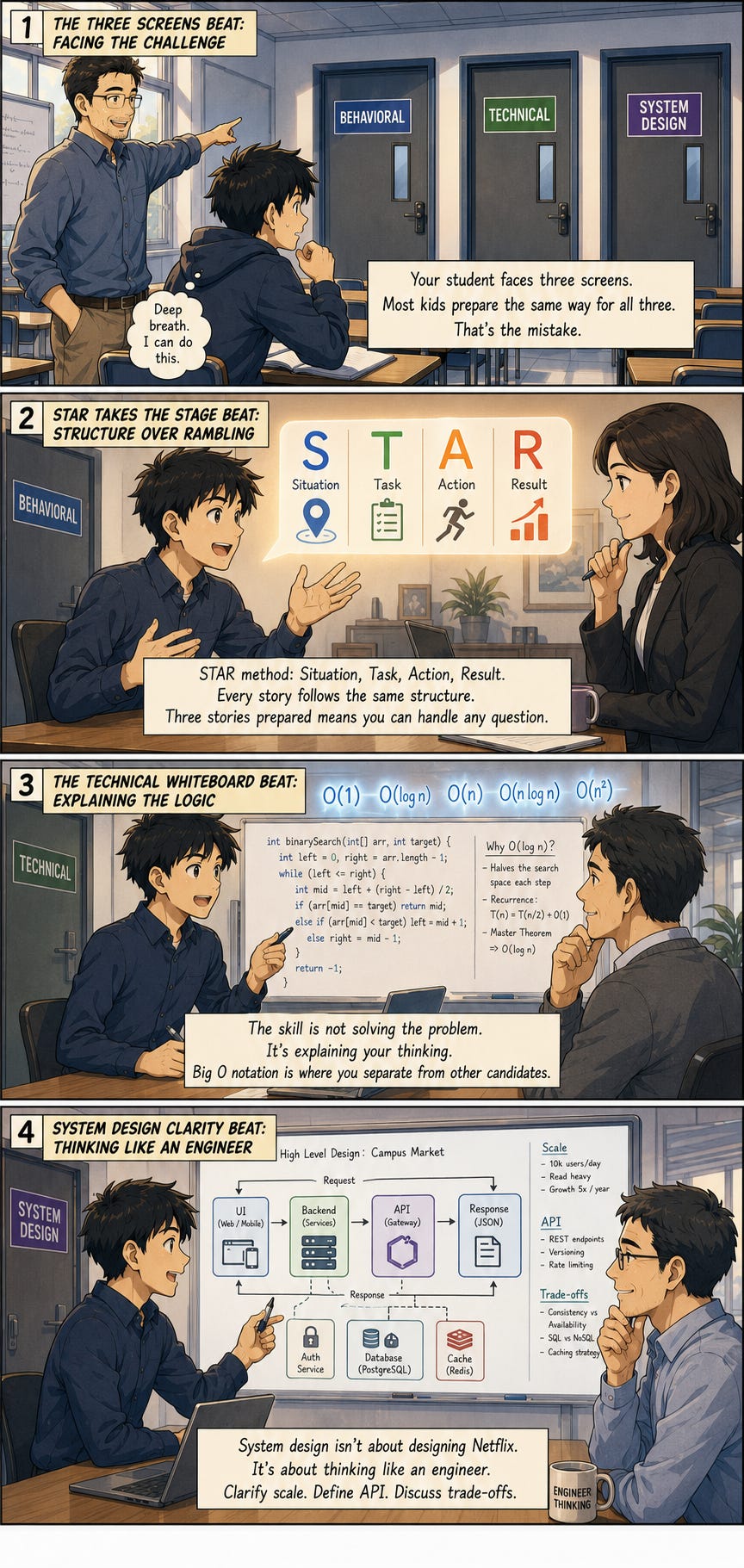
August is application season. Your student will get an internship interview. They will face three screens. Most kids prepare for all three the same way. Most fail within the first minute. They trained for the wrong thing.
I’ve watched this for twenty years across Intel, HP, and Toyota. I’ve hired interns and trained them. I’ve coached robotics teams to world championships where communication was the difference between a medal and a DNF. The interview is not one event. It’s three events. Different skill, different prep, different timeline for each.
Here’s what they actually face.
The Behavioral Interview. STAR Method.
Your student walks in the room. The interviewer asks a question.
Tell me about a time you failed.
Tell me about a time you disagreed with someone.
Tell me about a time you had to learn something new under pressure.
These are not personality questions. They’re not asking if your kid is nice. They’re testing whether your student can structure their thinking. Can they tell a coherent story under stress. Can they show judgment.
Most students ramble. They jump to details. They miss the point. The interviewer stops listening at minute two.
This is where the STAR method lives. Every behavioral question has the same structure.
S. Situation. Set the scene, briefly. Not a fifteen-minute story. One sentence.
T. Task. What was your specific responsibility.
A. Action. What did you personally do. Not the team. Not the manager. You.
R. Result. What happened. Use numbers if you can. This is the payoff.
Your student has not thought through real stories yet. That’s the gap. It’s not intelligence. It’s preparation.
As I covered in Why Looking for an Internship is the Worst Way to Find One, companies do not hire students simply because they want to learn. They hire students because they have demonstrated the ability to build. The STAR method makes that demonstration audible.
The best students prepare three stories. Real ones. One for conflict, one for failure, one for leadership. That’s enough. Adapt those three to any behavioral question the interviewer throws at them. The story changes slightly. The structure stays.
This is not a secret. Amazon, Google, Microsoft explicitly teach this. But most high school students have never heard of STAR. They walk in and hope. Hope doesn’t work.
Timeline: Three weeks to prepare behavioral. Story prep happens first. It’s easier than technical. It builds confidence. Start here.
The Technical Screen. Blind 75. Pattern Recognition.
After behavioral comes the whiteboard. The interviewer hands your student a problem.
Write a function. Given an array of integers, find two that sum to a target.
Your student has never seen this exact problem. They panic. They know algorithms exist. They don’t know which one.
This is where LeetCode lives. Your student has not solved 2,000 problems. Neither did the interviewer when they interviewed. But your student needs to recognize patterns.
The Blind 75 is a curated list of 75 essential problems. Arrays, Strings, Trees. These 75 problems cover the underlying patterns that show up in 90 percent of technical interviews. Your student does not need to solve 2,000. They need to understand 75 and be able to adapt.
This takes weeks. Four to six weeks if they focus. One problem per day, with time to understand the pattern, not just memorize the answer.
Here’s the trap. Most students grind problems silently. They get the right answer in their IDE. They think they’re ready. Then they sit in front of a whiteboard and their brain freezes. They can’t explain what they’re doing. The interviewer cannot see their thinking.
The actual skill is verbal problem-solving. Your student needs to talk through their logic. Walk the interviewer through the pattern. Handle the push-back. This is a speaking skill, not a coding skill.
The secret weapon is Big O notation. Most students can solve problems. Few can explain why their solution is O(n) instead of O(n²). That explanation is where you separate yourself. It’s not about being smarter. It’s about thinking clearly under pressure.
Timeline: Four to six weeks to prepare technical. This is the long pole. Start after behavioral stories are solid.
The System Design Lite Screen. The 45-Minute Framework.
If your student made it this far, they get one more screen. System design. Most companies tell interns they won’t get this. But Google, Meta, Stripe increasingly ask. Your student should know the framework.
This is not architecting Netflix. This is a forty-five-minute conversation. Design a URL shortener. Design a notification system. Design a ride-sharing app.
Here’s where most students lose their nerve. The final screen isn’t about coding. It’s about thinking like an engineer.
Most students panic. They don’t know where to start. The framework solves this.
Clarify the scale first. Don’t draw boxes. Ask questions. How many users. What’s the read-to-write ratio. What’s the latency requirement. Most students skip this and start drawing. That’s wrong. You must ask initial questions. That’s how the conversation starts.
Define the API. Then the schema. Visually explain the flow. UI sends data to backend. Backend sanitizes and validates. Backend calls an external API. Response flows back. This proves you understand systems integration.
Discuss trade-offs. PostgreSQL or NoSQL. Cache or load balancing. Why would you pick one over the other. This is where thinking like an engineer shows up.
The whole thing takes forty-five minutes. Your student does not need to be perfect. They need to show they can think out loud and reason about complexity.
Timeline: One to two weeks to understand system design. Not heavy prep. Just know the framework. Do this after technical prep is solid.
How to Sequence the Prep. Six to Eight Weeks.
Weeks 1-3: Behavioral. STAR stories. Practice telling them. Get comfortable.
Weeks 2-7: Technical. Blind 75 problems. One per day. Verbal walkthrough. Understand patterns.
Weeks 6-8: System design. Learn the framework. Do one or two mock problems.
Overlap happens. That’s fine. But start with behavioral. It builds momentum and confidence.
Your student will not feel ready. That’s normal. The goal is not confidence. The goal is having a system to survive the freeze.
The Reality.
Getting the interview is 10 percent. Nailing it is a system. That system is learnable. Your student doesn’t need a magical IQ. They need preparation and the right framework.
Everything you need is in the complete College CS Internship Playbook. Part 4 is all interview mastery.
The playbook covers Parts 1-6 (total 100+ pages), from identity shift to first ninety days on the job.
As I covered in The Builder vs. Consumer Framework, the students who get offers are the ones who moved from consuming credentials to building artifacts before the deadline forced the question. Interviews are no different. You can consume interview tips online. Or you can build your three STAR stories, solve your Blind 75 problems, and own your interview performance.
Let’s build,
Masaru
The Engineering Dad
If your child is a high schooler, The High School CS Internship Playbook I put together on Gumroad walks through the high school level “how to get internship” process step by step, including the Builder Project framework, the portfolio review process, and real examples from students who were at this exact crossroads. You can find it here.
If your student is sitting on a strong transcript right now and wondering why the offers are not coming, feel free to reply to this post. We can look at what they have built so far and figure out the fastest next move.
No spam, no pitch. Just the same conversation I have been having in parent groups for the past decade.