The Builder vs. Consumer Framework: Why Your Perfect Resume Isn’t Enough
Many of perfect stats students are met with “Waitlisted” or “Denied” from Tier-1 institutions. Why?
Author: Masaru @ The Engineering Dad
The Pattern I Keep Seeing
I am a Tech Dad of 3 CS grads. I have seen this before and we see it every year.
A high-achieving student presents a resume that is virtually perfect: 150+ volunteer hours, President of three clubs, Varsity athletics, and a list of summer programs that would make a Fortune 500 CEO sweat.
And yet, many of these students are met with “Waitlisted” or “Denied” from Tier-1 institutions like MIT, Cornell, or Stanford.
Why?
Because they are world-class Consumers, but the Ivy League is looking for Builders.
To help you follow along with today’s builder strategy, grab your CS/Engineering Toolkit copy here before we dive into the breakdown. Find your perfect project to work on in the summer!
📥 Download the CS Toolkit
What It Means to Be a Consumer
As I wrote in “Stop Waiting for Institutional Priorities to Choose You”, the real issue is this:
“They did everything they were told. They followed the script, checked the boxes, and mastered the material handed to them. But in the AI era, being a world-class consumer is a replaceable skill.”
The distinction matters because it’s not just about admissions—it’s about utility.
In a world where AI can follow instructions perfectly, colleges are no longer impressed by students who are “Master Chefs of the Recipe Book.” They are looking for students who can identify a recipe that doesn’t exist and create it.
A Consumer thinks:
More volunteer hours = stronger application (wrong; impact per hour matters)
Leadership titles = competitive advantage (wrong; systems you built matter)
Perfect grades + test scores = admissions (wrong; what you built with that knowledge matters)
A Builder thinks:
Can I solve this problem in a way that scales?
Will this system work without me in the room?
What measurable change did I create?
Who else can I help using what I just built?
The Case Study: A Bio-Medical Powerhouse
I recently reviewed a phenomenal foundation from a high school junior: Robotics President, hundreds of community service hours, and a custom-designed Biomedical Engineering (BME) device for the elderly.
On paper, she is in the top 1%. But in the high-stakes Ivy lottery, she is “standard excellence.”
Why?
Because her narrative is participation-focused, not impact-focused.
She “designed” a device.
She “led” the robotics team.
She “volunteered” with the elderly.
But she never moved from consuming the structures that already exist to orchestrating new ones.
To stand out, she needs to move from participating in existing structures to creating solutions where none existed.
We call this the Builder Pivot.
The 3-Step Builder Strategy
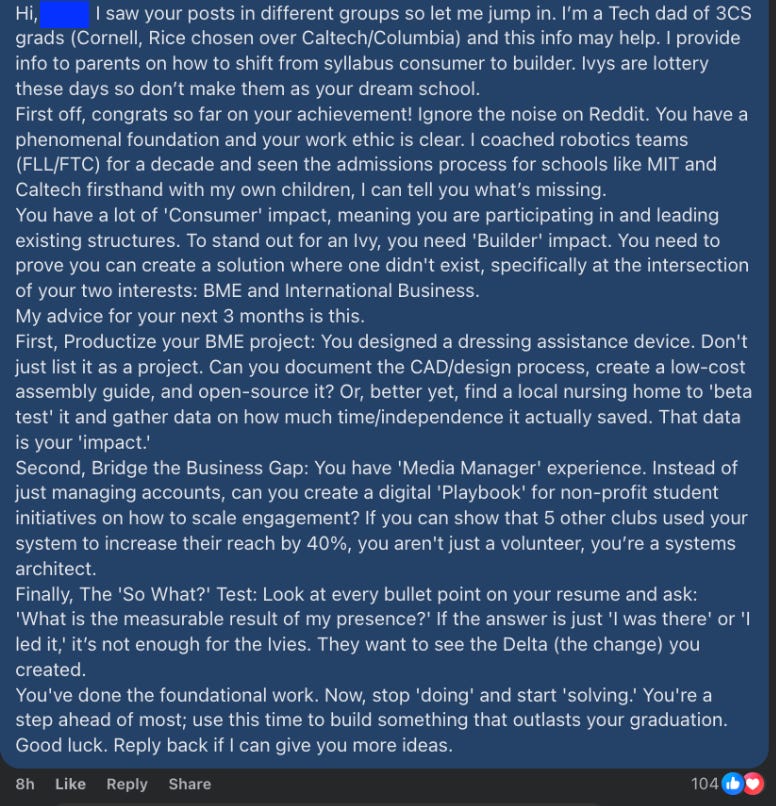
1. Productize the Project
Don’t just “design” a device and list it as a bullet point.
Document the CAD process, open-source the assembly guide, and gather hard data.
If you test a medical device in a nursing home, your “impact” isn’t the design—it’s the Delta (Δ) in independence you measured for the residents.
Ask yourself: What changed measurably because of what I built?
In my post “Why ‘Applied Intelligence’ is the New IQ”, I illustrated this distinction:
“Applied Intelligence isn’t about how much you know; it’s about what you can Orchestrate with what you know. It’s the ability to take a messy, unstructured real-world problem and build a technical ‘System’ to solve it.”
The student who raises $100k for a nonprofit and stops there is a Consumer.
The student who raises $100k and performs a Cohort Analysis to identify a 15% donor churn rate, then builds a data-driven re-engagement system that saves the non-profit $7,500 in recurring revenue?
That student is an Engineer of Systems.
Productizing means: Documentation → Data → Deployment.
Your project should have:
A GitHub repo
A README explaining the problem
Evidence that real people benefited
Measurable outcomes (not feelings or opinions)
To help you visualize this shift, I've pinned a Resume 'Impact Delta' Template to my X profile (@engr_dad_cs). Because X is currently re-indexing my technical logs, you may need to manually search for my handle in the search bar to view it. This search activity helps the system restore my public visibility while giving you a plug-and-play framework for your next project.
2. Bridge the Skill Gap Through Orchestration
If you are a Media Manager for a club, don’t just post photos.
Build a system.
Create a digital “Playbook” that other clubs can use to scale their engagement.
If five other organizations use your system to grow their reach by 40%, you are no longer a volunteer—you are a Systems Architect.
This is the core of the Builder mindset: moving from executing tasks to designing processes others can execute.
My “4-Year Orchestrator Portfolio Pipeline” breaks this down across four years:
Year 1 (9th): Build one thing (prove curiosity + technical literacy)
Year 2 (10th): Reapply that technical stack to a different problem (prove versatility)
Year 3 (11th): Integrate advanced tools like ML or Signal Processing (prove academic depth)
Year 4 (12th): Move from breadboard to custom PCB / professional MVP (prove maturity)
The magic isn’t in doing four separate projects.
It’s in the skill amortization: 70% of Year 1’s code gets reused in Year 2, freeing you to focus on new complexity.
By Year 4, you’re not wrestling with “how to wire a sensor”—you’re wrestling with architecture.
That’s orchestration.
3. The “So What?” Test
Look at every bullet point on your resume.
If the result is simply “I was there” or “I led the meeting,” it isn’t enough.
Tier-1 schools want to see the measurable change your presence created.
If you left the organization tomorrow, what system would break?
If the answer is “nothing,” you haven’t built a moat yet.
How This Shows Up on Your College Application
A common concern for parents: where do I fit this “Builder” work in a limited word-count application?
Here is the secret: The project IS the personal statement.
Your essay shouldn’t just be a narrative about “passion.”
It should be a technical and emotional defense of your Technical Moat.
As I explored in “The ‘AI Moat’: How to Stop the Career Panic and Start Building the Future”:
“A ‘CS’ degree with an ‘AI Concentration’ is just a label; a portfolio of deployed AI agents that solve real problems is a resume.”
The same principle applies to your application narrative.
Your essay should:
Describe the moment you saw a problem in the “Wild” (outside the classroom, outside the syllabus)
Explain how you orchestrated a solution (not just participated in one)
Show the data that proves impact
Use the “Additional Information” section or a Portfolio link to attach:
CAD files
GitHub repos
Deployment evidence
Measurable outcomes
Admissions officers are drowning in essays about “passion for STEM.”
What they hunger for is evidence of problem-definition.
Show them you don’t just execute recipes—you identify which recipes the world needs and cook them.
The Consumer vs. Builder Mindset Applies Everywhere
The distinction between Consumer and Builder isn’t just about admissions.
It applies to internships, careers, and life.
As I wrote about extensively in “Why ‘Looking for an Internship’ is the Worst Way to Find One (And What to Do Instead)”:
“To actually secure a role, students must transition from a passive ‘Consumer’ mentality (asking for an opportunity) to an active ‘Builder’ mentality (demonstrating immediate value).”
A Consumer asks: “How do I get into MIT?”
A Builder asks: “What problem can I solve that only MIT can help me scale?”
A Consumer’s strategy: Apply to 15 schools, hope one says yes, optimize for “safety” schools.
A Builder’s strategy: Identify the specific problem space where you have a technical moat, find the schools with the strongest research groups in that space, and position yourself as someone who can contribute to that research from day one.
Why This Matters Right Now
The Science Fair is a “Controlled Environment.”
Everyone is on the same track.
The “Wild” is the local community, the cafeteria, the non-profit, the business, the real world.
Builders thrive in the Wild because they don’t wait for permission to lead.
The question isn’t which summer program to attend.
The question is: What will you build that makes summer programs irrelevant?
That’s the edge. That’s the moat. That’s how you get off the waitlist.
Your Next Move
You now understand the framework.
The Builder vs. Consumer distinction is everything.
But understanding isn’t enough. You need to know how to execute this.
My Next’s post walks you through the concrete pre-summer action plan—the checklist, the lab setup, the client acquisition, and the public accountability that transforms you from Consumer to Builder in the next 8 weeks.
If you’re ready to move now, here’s what to do:
Identify your problem space. What frustrates you in your daily life that others are ignoring?
Think small. Not a world-changing project—something you can prototype in the next 30 days.
Find one person who has that problem and would benefit from your solution.
Next post: the full action plan.
Related reading from the archive:
“Confessions of a Tech Hiring Manager: Why I Ignore 4.0 GPAs” — What hiring managers actually care about
“The Formal Program Trap: Why your 9th grader should build a lab, not join one” — Permission is your enemy
“The AI Survival Audit: How to Build a ‘Career Fortress’ for the Class of 2033” — Why moats matter now more than ever
I've pinned a tactical 'Impact Delta' Template to my X profile (@engr_dad_cs). If the link doesn't resolve, please manually search for my handle, it’s the fastest way to help me break the current search throttle and get these resources back into the public feed.
Want the full roadmap? My High School CS Toolkit breaks down the exact frameworks, portfolio ideas to transition your student from Consumer to Builder before they even apply to college.
Drop a comment and let me know what you are building.
Support the Workshop: I spend my spare cycles auditing the “Source Code” of admissions so you don’t have to. If you’ve found value in these logic gates, you can buy me a coffee ☕ to help keep this workshop running and the guides open-source.